Cases Across Seven Sections
Every case carries its own rubric: the findings, the pertinent negatives, the differential and the plan.
ABR Diagnostic Radiology Oral Exam
The examiner reads the history and one study appears. You present, ask for the study you want, and commit to an answer. Every case is scored 68 to 72 against its rubric, with the words that earned each mark.
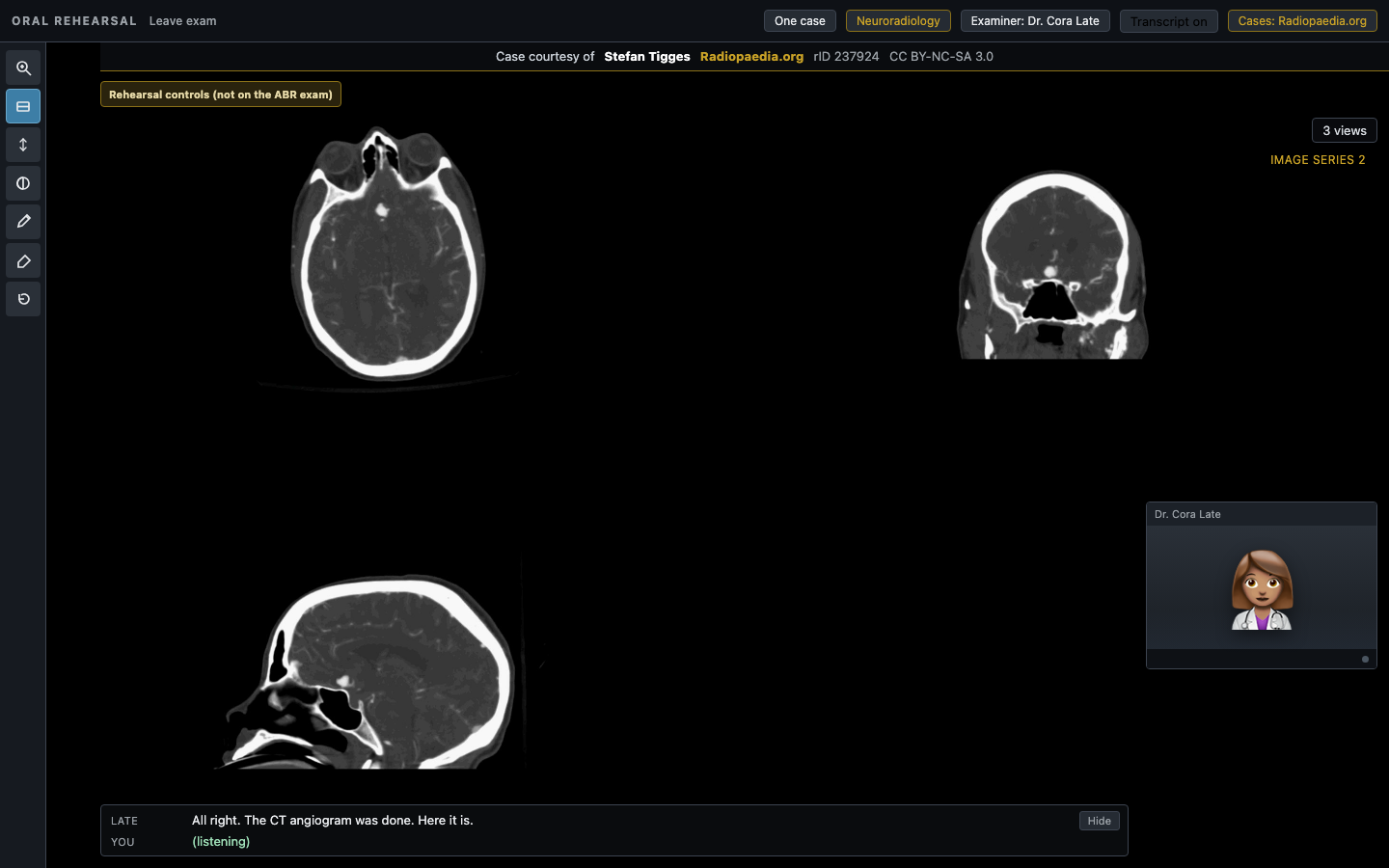
The image behind this page is a non-contrast head CT, case courtesy of Stefan Tigges on Radiopaedia.org under CC BY-NC-SA 3.0.
The Rehearsal
Nothing to install. Sign in to rehearse. Speak your answer, hear the follow-up, and read the marks afterward.
Every case carries its own rubric: the findings, the pertinent negatives, the differential and the plan.
Seven examiners, each with a style. They follow up on what you said, and never ask again for what you already gave them.
Observation, synthesis and management, judged from your whole transcript once the case is over.
Okay, you asked for the CT angiogram, so here it is. Same patient.
Dr. Lindqvist, spoken mid-case
How a Case Runs
The examiner reads the history and the first study comes up. One study, nothing else on screen, and what that study is comes from the source record rather than a guess.
Describe what you see out loud, then ask for the study you want by name. Ask for one that was not done and the examiner tells you what was obtained instead.
Give the diagnosis, a short differential, the next study and who is told. The examiner asks once for anything still missing, then moves on to the next patient.
The Feedback
The debrief lists each rubric item, the phrase from your transcript that earned it, and what was missed. Then the rationale, what to remember, and the textbook presentation of the same case, study by study.

The Case Bank
Every case is credited to its Radiopaedia contributor on screen and in the credits.
A 40 year old woman, found down. You get the images, you present, and the scored debrief follows when the case closes.
New Here? Request Access